A Five-Minute Review for Closing the Week
A five-minute weekly review helps you close the week with a clear note about what to carry forward, release or leave unresolved, without turning reflection into homework.
Friday evening: the kettle clicks off, and your open tabs still seem to be making demands. A five-minute weekly review can help you close the week by deciding what to carry forward, what to set down and what can remain unfinished.
This is not an audit of your choices or a search for a lesson in every event. It is a small closing ritual: leave a brief note that helps the week feel less like an open browser window. Three lines will do.
What is a five-minute weekly review for?
A week often ends with practical loose ends: an email to answer, a book to return, a conversation still on your mind. A short review gives you a place to park them, instead of carrying each one into the weekend as a vague obligation.
Use the time to make a simple distinction: what needs a next action, what can wait, and what is finished. You do not need to account for every day or turn an ordinary week into a story about who you are. If nothing needs carrying forward, the review can end there.
How do you make it a useful closing ritual?
Attach it to something already happening at the week’s edge: after closing your work computer, while tea steeps or as you put a notebook away. Use a scrap of paper, a notes app or the back of a calendar page. A timer can help you stop; special stationery and a quiet house are not required.
Write one brief line under each prompt:
- What is complete? Name a finished task or exchange, even if it was small. If there is a clear endpoint, mark it done; if part remains, write down the unfinished part rather than treating the whole matter as complete.
- What still needs a place? Note a loose end, such as a message to answer or an item to return. If you can name a manageable next action, record it; if not, note what information or decision is missing.
- What can wait? Identify something you do not need to settle tonight. If it has a real deadline or depends on someone else, note when or how you will revisit it; otherwise, let it stay off the page for now.
Keep the wording concrete. “Sort the paperwork” may feel like an entire afternoon; “put the letter beside the laptop so I can check the date” gives the task a visible foothold. For a matter that cannot be resolved yet, write “waiting for a reply” rather than inventing a next step.
What should you write down before you stop?
The best note is useful to your future self, not impressive to an imaginary reader. Include just enough context to recognise the matter later: “Return library book after work” is clearer than “book”; “Ask Maya which day suits her” is clearer than “message”.
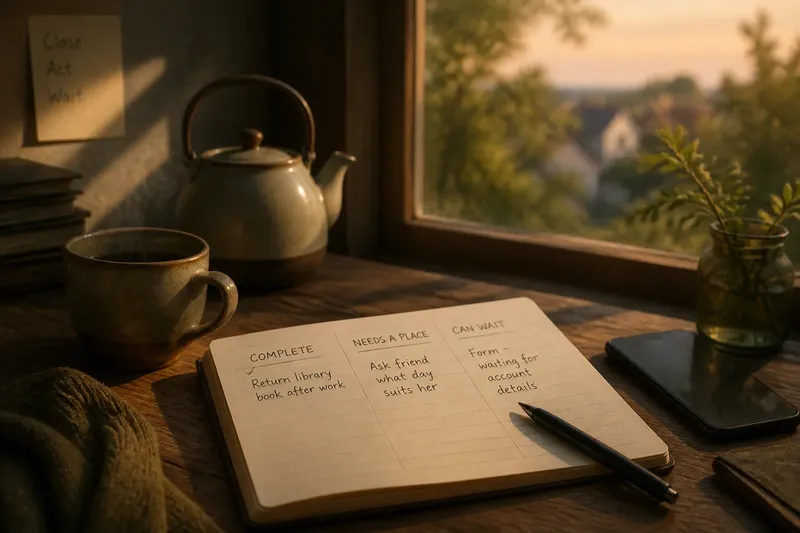
Say you have a library book by the door, a message from a friend you have not answered and a form that needs details you do not yet have. Write “return book after work” under complete or next action, depending on whether you have returned it; write “ask friend what day suits her” as the next action; mark the form “waiting for account details” and leave it unresolved. The result is not a plan for your whole weekend. It is three distinct decisions: finish, act, wait.
Some matters belong nowhere on the page. A passing irritation, a task someone else owns or a problem you cannot influence may not need a note. The review is for useful closure, not for collecting every thought you had.
How can you keep the review brief and kind?
End when the timer rings or the three lines are clear enough. Resist explaining every choice or adding a second list to manage the first. What is not worth the effort: scoring the week, documenting every unfinished task or building an elaborate filing system for a few reminders.
If a line brings up a complicated issue, give it a modest marker—“needs a conversation” or “not ready to decide”—and stop. You can return to it when you have the time or information. The note is allowed to describe uncertainty without pretending to solve it.
What if you cannot decide what to carry forward?
What if everything still feels unfinished?
Choose only the matters with a real next action or a clear reason to revisit them. Put the rest aside for now; a review does not need to become a complete inventory.
What if you do not know the next step?
Write what is missing, such as a reply, a date or a decision from someone else. If the missing piece is yours to clarify, note one question to answer when you return to the matter.
What if you miss a week?
Resume at the next natural stopping point without reconstructing the gap. The purpose is to close the week in front of you, not repay a missed ritual.
What if you would rather not keep personal notes?
Write the lines on scrap paper, use them to make any needed reminder, then discard the page. The review can leave no permanent record.
Where should the notes go after the review?
Put reminders where you will actually meet them: a calendar entry for a date, a task list for an action, or a note beside the item you need to bring. If a matter depends on another person, keep the reminder neutral and specific rather than guessing what they will do.
Not every line needs follow-up. A review can end with nothing more than a clear sense that a few things are finished and the rest can wait. Close the notebook or put the phone away; a good stopping point is part of the practice, too.